Natalia Krešić
Activist

Natalia Krešić

On turning a half-forgotten scientific fact about local water into a movement that brought a community back to its source.

I think every water needs a story.
From
Croatia
Who is our guest?

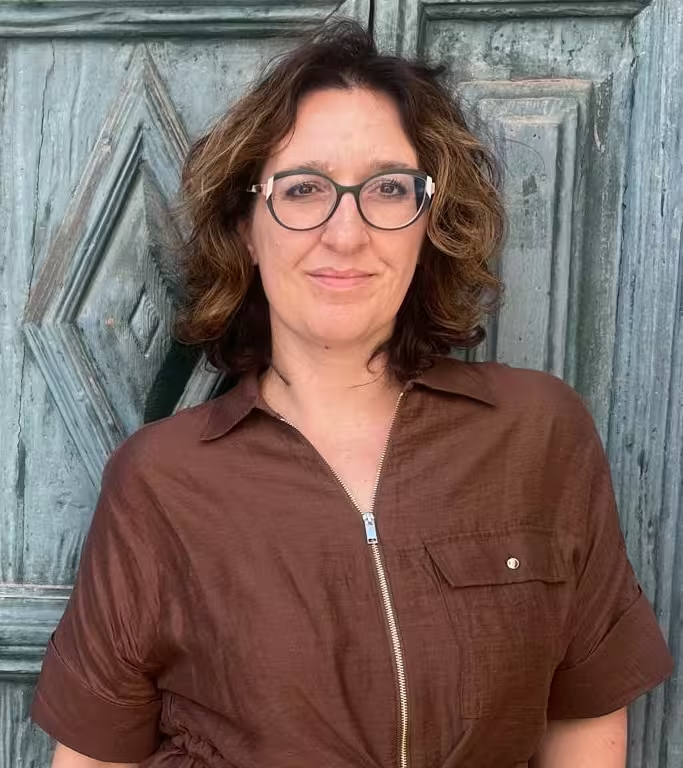
Natalia Krešić is a marketing and travel consultant in Zagreb with a master's in e-tourism and a sustainable tourism certificate. She believes in strong local identity and authenticity. After ten years in the corporate world, she started her own consultancy. With Tina Vickov, she co-authored Small Giants Water.

Why are we interviewing our guest? 

A tourist board, a free glass of water and a story attached to it. Then the network overtook the flow. This conversation is about taking abundance seriously, and about what any region can learn from an idea that outgrew the people who started it.

What to expect

How giant newborns and record-tall teenagers became a story about water, a café owner born at five and a half kilos, museums, ateliers, libraries and a tourist ship that joined, and a professor's test for a story that is truly alive: the taxi driver tells the same one as the bartender.

The interviewer
Oliver Wegner
Founder of water.day

After 25+ years in tech, I'm dedicating my time to something that truly matters: water, our planet's most vital and overlooked resource. 💧 I'm driven by curiosity to meet changemakers whose insights and stories might inspire us all to reconnect with water.

Croatia has more water per capita than any other EU country. Why does this water need a story?
I think every water needs a story. Before climate change and species loss, we took nature for granted - you grow up somewhere without an obvious lack of water, and everything turns into convenience. I think we're slowly moving out of that convenience, and we need to raise awareness, across generations, about how fragile our resources really are. If we want people to feel responsible for their resources, storytelling is the best thing we can do. These stories aren't made up. They need to evoke emotion, so people start seeing nature as something alive, with a soul that needs protecting. I think we need to be friends with mother nature first, and then grow love. I know that sounds really emotional. But stories make people stop and think: I didn't know this. We have so much water, how is this possible? We are so lucky. Let's make that happiness tangible. I think these stories help transcend this state of ignorance to a state of activity. Before that, though, you need to be triggered.
Šibenik-Knin County is home to the tallest teenagers and the second-largest newborns in the world. What does that have to do with water?
These two findings became the bridge that brought the focus of the community to our water. They are documented in scientific research. In the 80s, macrosomic births were recorded in the hospitals of Šibenik and Knin, the two urban centres of the county, and local doctors followed up. Their conclusion: the second-largest newborns in the world, just behind the Cherokee. But the research was never concluded, and the findings stayed in the dark until my colleague Tina heard about them at a congress and thought: _how is it possible that nobody is doing anything with this fact?_ Later we found research showing teenagers on the Dalmatian coast and in its hinterland are the tallest in the world. And what does this have to do with water? Genes are the main reason, of course, but one of the original doctors also pointed to sun hours, soil and water quality, a fruitful environment where life literally thrives.
How did you and Tina Vickov turn those two data points into what became Small Giants Water?
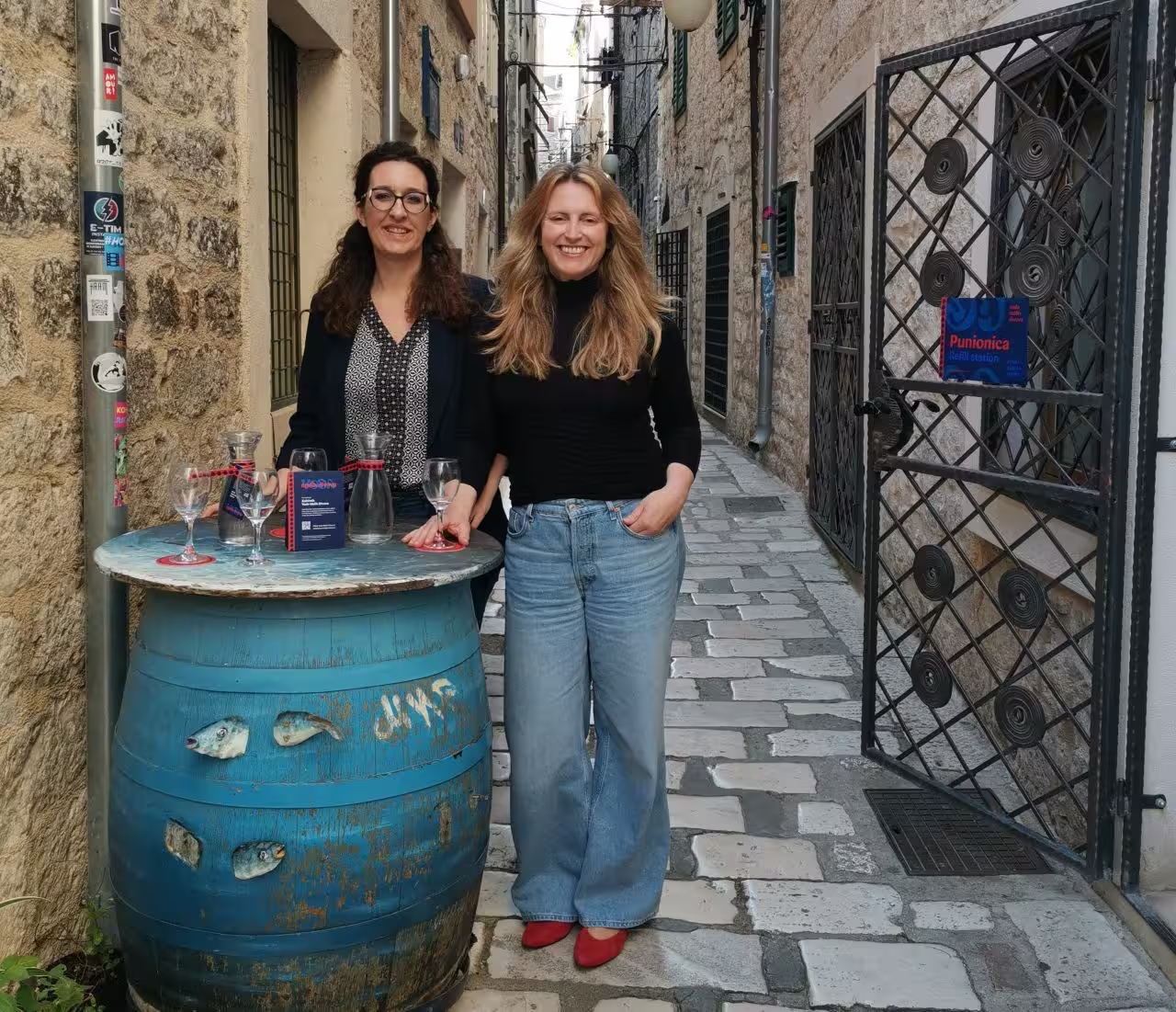
We thought about how to convert these remarkable facts into something positive for the region, in connection to tourism. That became Small Giants Water, an initiative for free access, promotion and protection of the drinking water of Šibenik-Knin County. We presented the idea and our development strategy to the County Tourist Board, and they gave us the green light to test the idea with real people and see whether local businesses would be willing to get involved. The overall idea is to brand the destination, so people who come don't just stroll around, they get to know this is a region where life is really full. Marketing campaigns used to be just postcards, today they also bring out the lifestyle. But they are one-layered, paid for and done after one season. Ours has surprising end results, and one of the main things is that the story lives on. Later we connected it to the sports people. Many things have the potential to make this story more credible. I must say that Dražen Petrović, for example, one of the best basketball players in the world, comes from Šibenik. Just as a reminder.
What did you hear when you first asked cafés and hotels to give water away for free?
We wanted this to be more than a nice story, something tangible: a refill network of cafés, bars and restaurants with a sign saying they're proud Guardians of Small Giants Water. Anyone can refill a bottle there, and seated guests get a free jug of water with a label inviting them to discover the story. First came a pilot with 25 to 30 establishments across the county. We didn't know what to expect, but we were positively surprised. The story made them sit and listen, and 90% of the people we approached joined. That gave us a boost to go forward and develop the branding. Those first interviews are still vivid for me: we were introducing something nobody had heard of yet, in the middle of a hectic midsummer season, but it was very rewarding. Today there are more than 120 refill stations, over 20 accommodations, two museums, two libraries, two ateliers and a tourist ship. The network overtook the flow, and people came to us.
Jug Small Giants Water
Interview break
Get to know our guest

Learn small facts about our interviewee.

Favourite place
Barcelona (especially Gràcia neighbourhood where I used to live for a year)
Favourite Book
Life of Pi, Yann Martel
Favourite song
Imagine, John Lennon
One piece of advice
Chase your passion and make decisions that feel right, not just those that make sense.
Biggest challenge
From time to time I need to preserve my energy and clarify focus which requires laying low and saying "no" to many things. It's a win-win for me, so I keep on.
Favourite movie/series
The Crown and Love Actually
Beyond the numbers, framing water as "a reconnection to homeland" is a striking idea. Where did you first see it in someone's reaction and what does that phrase mean to you personally?
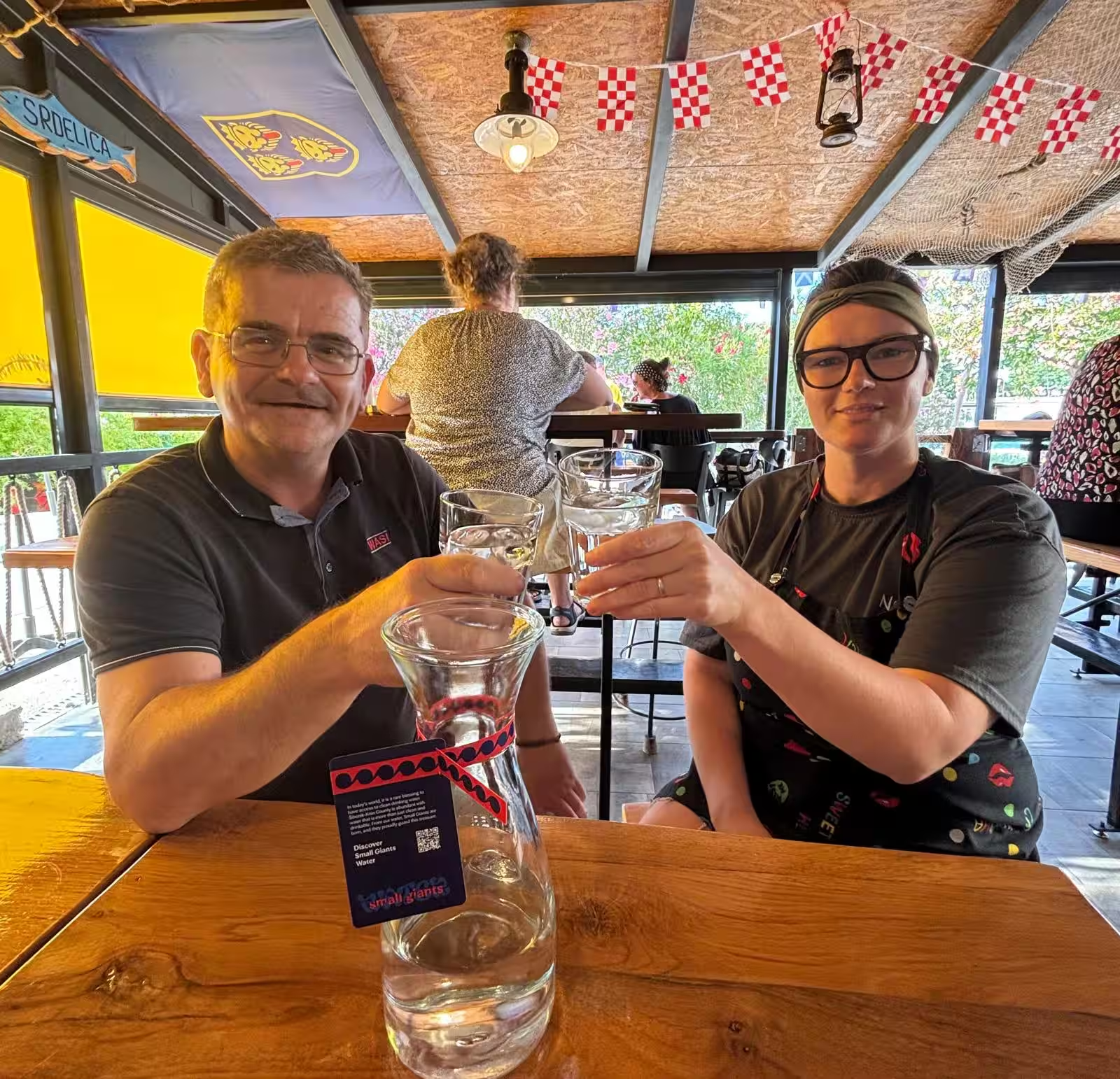
I remember one café owner in Šibenik. When we told him about the macrosomic children, all born at four kilos and up, he said he was born at five and a half kilos himself, then named family members born the same way. "Of course I'm going to join. We need to get this word around." A story like that creates an atmosphere where you just need to feel positive. Even before this started, I felt responsible for resources we take for granted just because they're here. I'm a personal ambassador, sometimes boring to my children: I never buy a water bottle, it feels ridiculous to me. We need to re-examine our choices of convenience. "Reconnection to homeland" puts it in short: we tell stories so people pay attention and feel connected to something that matters to them. The Krka River is magnificent, but behind its beauty is a fragile karst landscape. We need to reconnect to it, and protect it.
Small Giants Water was launched by the county's tourist board in 2024 as new destination branding. It has grown into a movement. What makes it last: for the water, and for the people?
Different layers of the public have been involved. We started with experts, so our claims about the water's quantity, quality and fragility would carry weight. In 2025 we held an open roundtable for World Water Day, where high-school students took part as a debating club alongside journalists, officials and activists. For World Water Day 2026, we made March the "month of water" in the county: teachers gave lessons on Small Giants Water, and the schools became guardians of water too. If children are moved by it, they become little ambassadors at home: "Have you known this? We should not do this anymore. We should do something differently." That comes from an internal source, so the initiative can live. The easiest thing would be to put up a billboard and hope people get it. What we did instead, the interaction, is completely different, and I think that's what makes it last.
Special question
You say empowering people makes an idea truly alive. How can another region find its own local story and start something similar?
Every region can identify its own strength - something authentic to itself: an ingredient, a plant, a landscape. If you dig into local history, nothing needs to be invented, it's usually already been mentioned somewhere. Good research, motivation, and people from different backgrounds can make any region recognisable. It doesn't depend on big budgets. But if an idea isn't known, and accepted, by the local community, I don't think it can live. Tourists are passers-by; this summer they're in Croatia, next summer somewhere else. It was Tina's idea to set up a registry for anyone born at four kilos or above and we had whole families sign up together, sometimes six members at once. All this reminds me of a professor in my destination marketing course who said: when you get into a taxi and the taxi driver tells you the same story as the receptionist, the guide and the bartender, then it's really alive, really authentic, not something you read in a brochure.
Key Takeaways & Quotes

What stayed with us from this conversation.

True stories make people stop and think: I didn't know this. A forgotten fact about newborns and teenagers waited for someone to act. It became Small Giants Water, over 120 refill stations strong, and it lives because the community owns it, not because of big budgets. Every region has an authentic strength, waiting to be told.

Our story opened so many doors we never even thought we'd knock on.
If an idea isn't known, and accepted, by the local community, I don't think it can live.
Discover more interviews like this
Interview
An interview with
Jean-Charles de Biolley
Fainta S. Negoro
Interview
An interview with
Fainta S. Negoro
Interview
An interview with
Dr. Peter H. Gleick
Yanny Peñaloza
Interview
An interview with
Yanny Peñaloza
Justina Muchelenje Water Witness
Interview
An interview with
Justina Muchelenje
Zosia Wiśniewska
Interview
An interview with
Zosia Wiśniewska
Finnian Mollet
Interview
An interview with
Finnian Mollet
Interview
An interview with
Scarlett Gonella