.svg)


Welcome,
!
Joining from
country
This area will display your personal quote or intention.

.svg)
Make this space your own.
Save favourites, track habits, and join the community.
Join the community
Already have an account? Sign In


The magazine of the

https://www.watermovement.world



Cleaning products exposed: The truth you need to know
The cleaning industry convinced you that every surface needs its own specialized chemical formula.
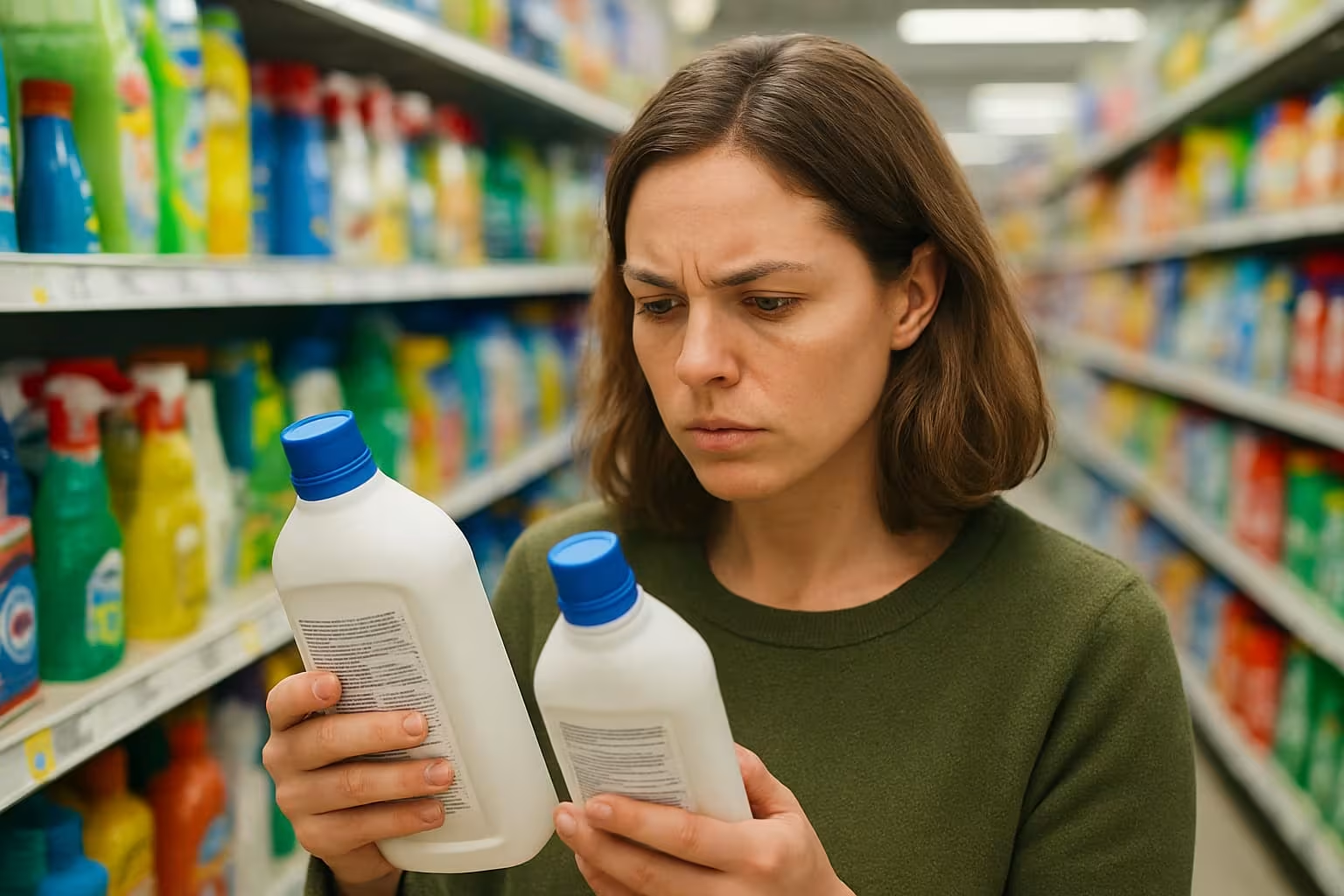
Walk into any cleaning aisle – it's like entering a parallel universe.

The marketing machine reveal
Walk into any grocery store's cleaning aisle and it's like entering a parallel universe where every single surface, stain, and smell apparently requires its own specialized chemical formula. There's toilet bowl cleaner, shower cleaner, glass cleaner, floor cleaner – the list goes on until your head spins and your wallet empties. But here's the reality check nobody wants you to hear.
The product category explosion
Your home has been colonized. Kitchen gets 3-4 products: degreasing agents, oven cleaner, dishwasher detergent, surface sanitizer. Bathroom arsenal: 4-5 bottles including toilet bowl cleaner with actual hydrochloric acid, shower cleaners, disinfectants. Living areas demand 2-3 more specialized formulations. Total damage: 15+ chemical cocktails marketed as "essential."

Pause & Reflect
You research every skincare ingredient but trust mystery chemicals under your sink?
The numbers that shock
The typical household stocks 15-25 different cleaning products, yet research shows multi-purpose cleaners can handle most cleaning tasks. We're paying for convenience we don't need while creating chemical experiments in our living spaces. The global natural cleaners market is exploding from €6.97 billion to €13.28 billion by 2030 (Expert Market Research, 2024) – people are waking up.
The four-function reality
Effective cleaning requires substances that break down dirt, kill germs, remove stains, and sometimes add fragrance. Four basic functions that could be handled by 4 to 5 products maximum. But the industry convinced us we need 15-25 different bottles. Most household cleaning can be accomplished with vinegar, baking soda, lemon, salt, and castile soap – centuries of proven wisdom.
.jpg)
The decision fatigue trap
Having too many options literally exhausts your brain. Studies show people with overstocked cleaning cabinets clean less frequently because choosing the "right" product becomes overwhelming. The industry created problem multiplication: every surface is different, every stain needs specialized treatment, every room has unique contamination requirements.
Sustainability beats convenience
Gen Z and younger millennials are leading a rebellion against product proliferation. Natural ingredient demand grows 11.3% annually. DIY solutions using basic ingredients trend on social media. They reject the "more is better" mentality, research ingredients obsessively, and question marketing claims. Young consumers share homemade cleaning recipes and prioritize authenticity over advertising, sustainability over convenience.

Pause & Reflect
What if great-grandmother's methods were more effective than your cleaning cabinet chaos?
The chemistry simplification
Recent research confirms what grandparents knew: effective cleaning is about understanding pH levels, surfactant action, antimicrobial properties, and mechanical action. One multi-purpose cleaner with right pH balance can replace 5-7 specialized products. One natural acid replaces 3-4 mineral deposit removers. Smart chemistry beats product proliferation every time.
These chemicals are usually unnecessary; microfiber cloths and water are more than enough for most purposes
Dr. Øistein Svanes, Department of Clinical Science, University of Bergen
The trend reversal
2025 market trends show consumers are done with the proliferation game: concentrated formulas reducing packaging by 80%, refillable systems eliminating single-use bottles, multi-functional products replacing entire categories, ingredient transparency revealing what you're actually buying. Smart manufacturers create universal cleaners that work instead of 15 bottles doing the same thing.

The simplicity that wins
Smart consumers discover that 3-4 high-quality, multi-purpose products can replace 15+ specialized cleaners. This isn't just minimalism – it's efficiency, cost savings, and health protection. Most cleaning challenges fall into four categories: grease and grime, mineral deposits, germs and bacteria, odors. You don't need 20 products to handle 4 problems.
The unavoidable truth
The truth becomes unavoidable: every additional cleaning product represents marketing over science, convenience over health, corporate profits over wellbeing. You've been systematically trained to believe effective cleaning requires specialized chemicals.
Reality? The industry's greatest success isn't better products - it's convincing you simple solutions don't work.
Closing thoughts
Your wallet, health, and storage space are waiting for you to embrace the radical simplicity that actually works better than the chemistry lab under your sink.
Did you like this article?
Other articles you might like

Dive Deep

Your AI habit is draining rivers in Aragon, Spain and Texas, US

Dive Deep
PFAS chemicals in water: what companies knew and you didn't

Dive Deep
.svg)
.svg)