.svg)


Welcome,
!
Joining from
country
This area will display your personal quote or intention.

.svg)
Make this space your own.
Save favourites, track habits, and join the community.
Join the community
Already have an account? Sign In


The magazine of the

https://www.watermovement.world



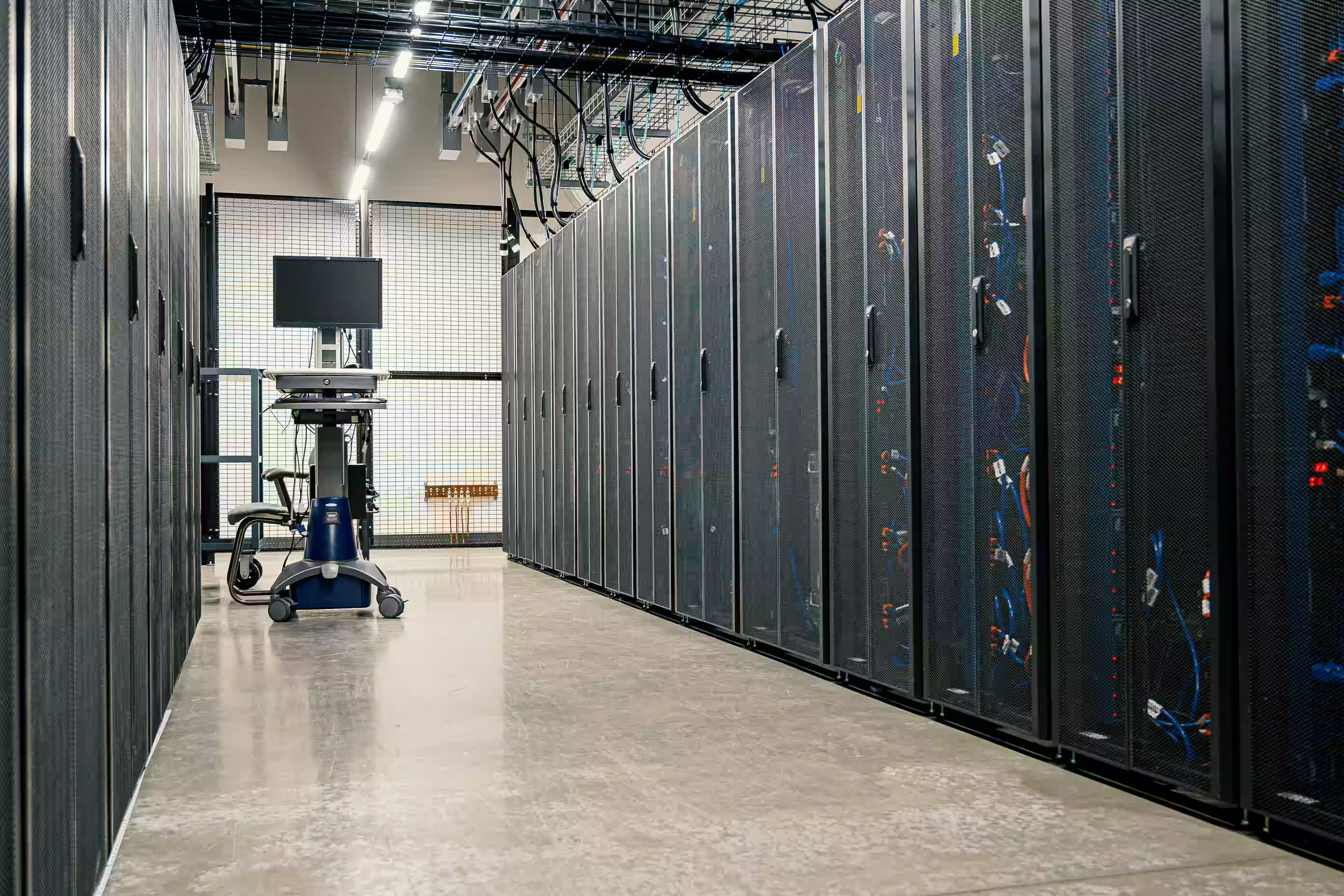
Your AI habit is draining rivers in Aragon, Spain and Texas, US
Your ChatGPT searches, image generators, and AI assistants drink fresh water. Here's what's actually happening.
A simple AI prompt can consume a bottle of water.

The invisible thirst of your screen
Every time you use ChatGPT, Gemini, Claude or any AI tool, servers in massive data centers process your request. These facilities need cooling to function - and most use fresh water. A 100-word prompt can consume around 500 milliliters of water, roughly one bottle. That might not sound like much, but billions of prompts happen globally every day. The math adds up fast when you're asking AI to write emails, generate images, or summarize articles.
Where does all this water go?
Data centers cool processors through evaporation - water transforms into vapor and enters the atmosphere. Cooling towers evaporate roughly 80%; chillers have similar rates. This doesn't return to local rivers or reservoirs. In 2024, Google's thirstiest Iowa data center consumed 2.7 million gallons (10.2 million liters) daily. Meta restored over 1.59 billion gallons to watersheds, but facilities still consumed massive volumes initially.

Pause & Reflect
Think about your last 10 AI promts. What were they for?
Not all prompts are created equal
The type of AI task matters significantly. Simple text queries use relatively little. Google's Gemini averages 0.26 milliliters per prompt, about five drops. Image generation is the most water-intensive, requiring substantially more cooling power. Advanced "reasoning" models can use 50-100 times more resources than basic queries. When you ask AI to generate a detailed image or process complex reasoning tasks, you're triggering far more computational work and water consumption than a simple question about the weather.
Europe faces its own water crisis
Amazon's Aragon facility needs 500 million liters (132M gallons) yearly - amid severe drought. The U.S. firm requested 48% more as Spain sought EU drought aid. 'Tu Nube Seca Mi Río' demands moratoriums on new facilities. Europe's use projected to double: 0.82 trillion liters (2025) to 1.58 trillion by 2030. Frankfurt, London, Amsterdam, Paris, Dublin took 85% of 2024's new capacity. Spain and Greece face highest water stress exposure.

What tech companies are actually doing
Major companies are implementing solutions. Microsoft's next-generation data centers use closed-loop liquid cooling that recycles water continuously, avoiding evaporation of 125 million liters per year per facility. Google reports improving water efficiency by 80% since early 2000s. Liquid immersion cooling can reduce water consumption by up to 91% compared to traditional air cooling. Direct-to-chip cooling targets processors at the source, minimizing overheating and excessive water use. These aren't future concepts - they're being deployed now.
Solutions you can actually implement
Your choices matter more than you think. Use AI intentionally - ask yourself if the task actually needs it or if a regular search would work. Batch your questions instead of multiple separate queries. Choose providers reporting efficiency metrics: Google's Gemini uses about 0.24 watt-hours per prompt; ChatGPT uses 0.34. That difference scales. When generating images, consider if you need AI or if stock photos or other tools work. Think of AI like driving - sometimes necessary, sometimes optional, always using resources.

Pause & Reflect
When was the last time you chose convenience over necessity?
The efficiency question nobody asks
Data centers measure efficiency through Water Usage Effectiveness (WUE) - liters consumed per kilowatt-hour of energy. The average across facilities is 1.9 liters per kWh. The goal is zero for air-cooled centers, but climate conditions often prevent this. Recent research discovered different cooling methods can vary efficiency dramatically. Hybrid systems combining liquid and air cooling optimize based on specific hardware needs. The question isn't whether to use water, but how efficiently facilities use it for the computing power delivered.
There is still much we don't know about AI's environmental impact, but some data we do have is concerning.
Golestan Radwan, Chief Digital Officer, United Nations Environment Programme
Why transparency changes everything
Only 51% of data center operators track water usage; just 10% monitor across all facilities. Companies rarely disclose water consumption for individual AI models. This prevents you from making informed choices. The 2024 Artificial Intelligence Environmental Impacts Act aims to mandate reporting standards. When companies publish detailed metrics, you can choose more efficient services and push for real accountability.

The bigger picture about resource use
A burger needs 400 gallons (1,514 L); a t-shirt 700 gallons (2,650 L). Golf courses use 100,000 to 2 million gallons (378,541 to 7.6 million L) daily. Context matters, but so does growth rate. AI infrastructure expands exponentially while other industries remain stable. Projected AI water demand: 4.2-6.6 billion cubic meters by 2027 - equivalent to Denmark's annual use or half the UK's. Expansion speed matters as much as absolute numbers.
Your relationship with AI tools
Understanding impact doesn't mean abandoning technology. AI enables genuine breakthroughs in medicine, climate modeling, and accessibility. The question is intentionality. Before using AI, ask: does this task need it? Could I accomplish this another way? Am I using the most efficient tool available? Support companies investing in closed-loop cooling and renewable energy. Demand transparency in environmental reporting. Your usage patterns, multiplied across millions, shape how quickly companies prioritize efficiency innovations.
Closing thoughts
Every query uses water - the question is whether what you're asking for is worth it. If you thought before hitting send, you might use less and still get what you need.
Did you like this article?
Other articles you might like
Dive Deep

PFAS chemicals in water: what companies knew and you didn't
Dive Deep
Your skin absorbs ocean minerals through pure physics
Dive Deep
.svg)
.svg)